
AI Prompts for Lawyers: 12 Prompt Patterns for Everyday Legal Work
By Avish Sharma, advocate. Published November 10, 2026. 7 min read.
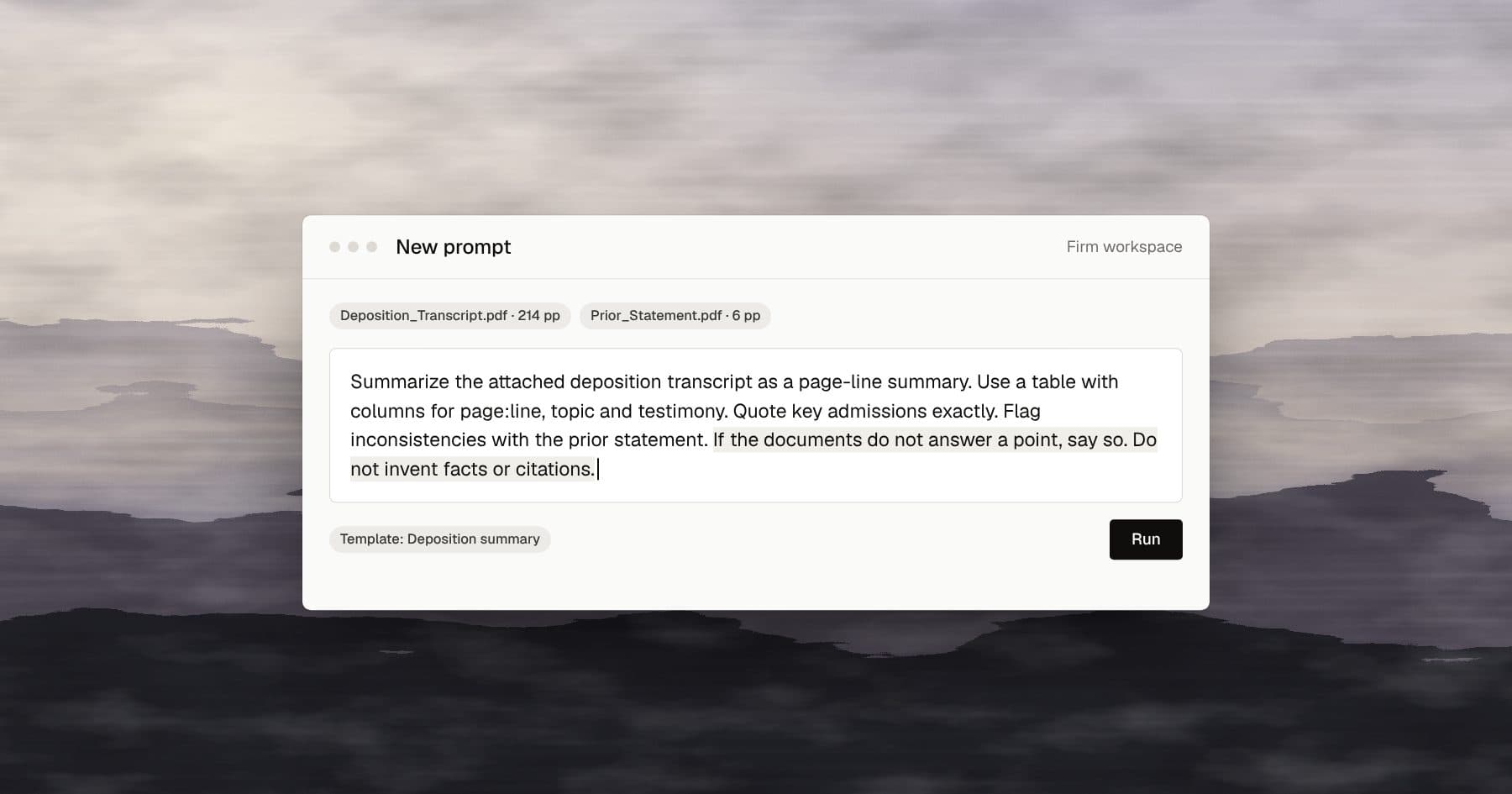
The difference between a useless AI answer and a useful first draft is usually the prompt. A good legal prompt tells the tool who it is working for, what it is looking at, what to produce and in what format, and what not to do. Below are the principles and twelve patterns you can adapt. Use them only in tools your firm has approved for client information, and check every output before you rely on it.
The Six Parts of a Good Legal Prompt
- Role and audience: "You are assisting a New Jersey personal injury attorney. The reader is the attorney."
- Task: one clear deliverable, such as a summary, a draft, a list of issues or a comparison.
- Material: the documents to work from. Tell the tool to rely only on them.
- Format: a table with named columns, a memo with headings, or a letter of a set length.
- Constraints: jurisdiction, tone, length, and the firm's style.
- Honesty rules: "Cite the page for every statement. If the documents do not answer a point, say so. Do not invent facts, quotations or case citations."
Summaries and Analysis of Documents
1. Deposition summary: "Summarize the attached deposition transcript as a page-line summary. Use a table with columns for page:line, topic and testimony. Keep the witness's wording for key admissions and quote them exactly. Flag inconsistencies with the witness's earlier statements in the attached documents."
2. Medical chronology: "From the attached medical records, build a chronology table with columns for date, provider, visit type, complaints, findings, diagnosis, treatment and source page. List gaps in treatment of more than 30 days and any prior injury to the same body part in a separate section."
3. Timeline from a document set: "Read the attached emails and documents and produce a chronological timeline of events relevant to [issue]. Cite the document and page for every entry. List any dates that conflict between documents."
4. Contract review against a checklist: "Review the attached agreement against the checklist below from the perspective of [party]. For each item, quote the relevant clause, state whether it meets the checklist, and suggest a revision where it does not. List any unusual or one-sided clauses not covered by the checklist."
5. Comparing versions: "Compare the two attached drafts of the agreement. List every substantive change in a table with columns for clause, earlier wording, new wording and practical effect. Ignore formatting changes."
Drafting
6. Demand letter: "Using the attached chronology and billing summary, draft a demand letter to [insurer] for [client]. Follow the structure of the attached sample letter. Use only facts that appear in the documents and cite the record for each injury and charge."
7. Client update in plain English: "Rewrite the attached memo as a letter to the client, who is not a lawyer. Explain what happened, what it means for them and what happens next, in under 400 words, without legal jargon."
8. Discovery requests: "Draft interrogatories and requests for production for [claim] in [court], based on the attached complaint and answer. Group them by issue. Keep within the numerical limits of the applicable rules and note which rule you relied on, so the attorney can confirm it."
9. Deposition outline: "Prepare an outline for the deposition of [witness], organized by topic, using the attached documents. Under each topic list the facts to establish, the documents to show the witness, and suggested questions."
Research and Review
10. Research starting points: "I need to research [issue] under [state] law. List the statutes, rules and legal concepts I should research, and the questions I should answer. Do not give case citations; I will find the authorities in Westlaw or Lexis." General-purpose models invent citations; use them to frame research, and use a legal research database for the authorities.
11. Checking a draft: "Review the attached brief against the attached local rules and the judge's standing order. List every requirement it does not meet, such as length, font, required sections or certifications, with the rule for each."
12. Testing an argument: "Act as opposing counsel. Read the attached brief and list the five strongest counterarguments, the facts in the record that support each, and where our brief is weakest."
Rules for Reliable Output
- Give the tool the documents. Answers drawn from its general training are where errors and invented authorities come from.
- Ask for page or paragraph references, then spot-check them.
- Break large jobs into steps: extract first, then analyze, then draft.
- Save prompts that work as firm templates or skills, so everyone starts from the best version.
- Never enter client information into a personal or free account.
- A person reads and checks everything before it is filed, served or sent. That is your duty under Rules 1.1, 3.3 and 5.3, and ABA Formal Opinion 512.
Let Us Run the Prompts
Prodigy LPO's lawyers use these patterns every day in Harvey, Legora, Claude and our own business accounts, then check every row, quotation and citation against the source. If you would rather receive a finished, verified summary or draft than write the prompts yourself, send us one task as a free sample.
Sources
- ABA Formal Opinion 512, Generative Artificial Intelligence Tools (July 29, 2024)
- Anthropic, Prompt engineering overview (Claude documentation)
- Mata v. Avianca, Inc., No. 22-cv-1461 (S.D.N.Y. June 22, 2023)
This guide is general information for lawyers, not legal advice. Check the current rules in your jurisdiction.
One Practical Guide a Month
Short, useful guides for US attorneys on legal AI, outsourcing and running a leaner practice. One email a month; unsubscribe in one click.