
ABA Formal Opinion 512 Explained: A Practical Checklist for Lawyers Using Generative AI
By Avish Sharma, advocate. Published November 10, 2026. 7 min read.
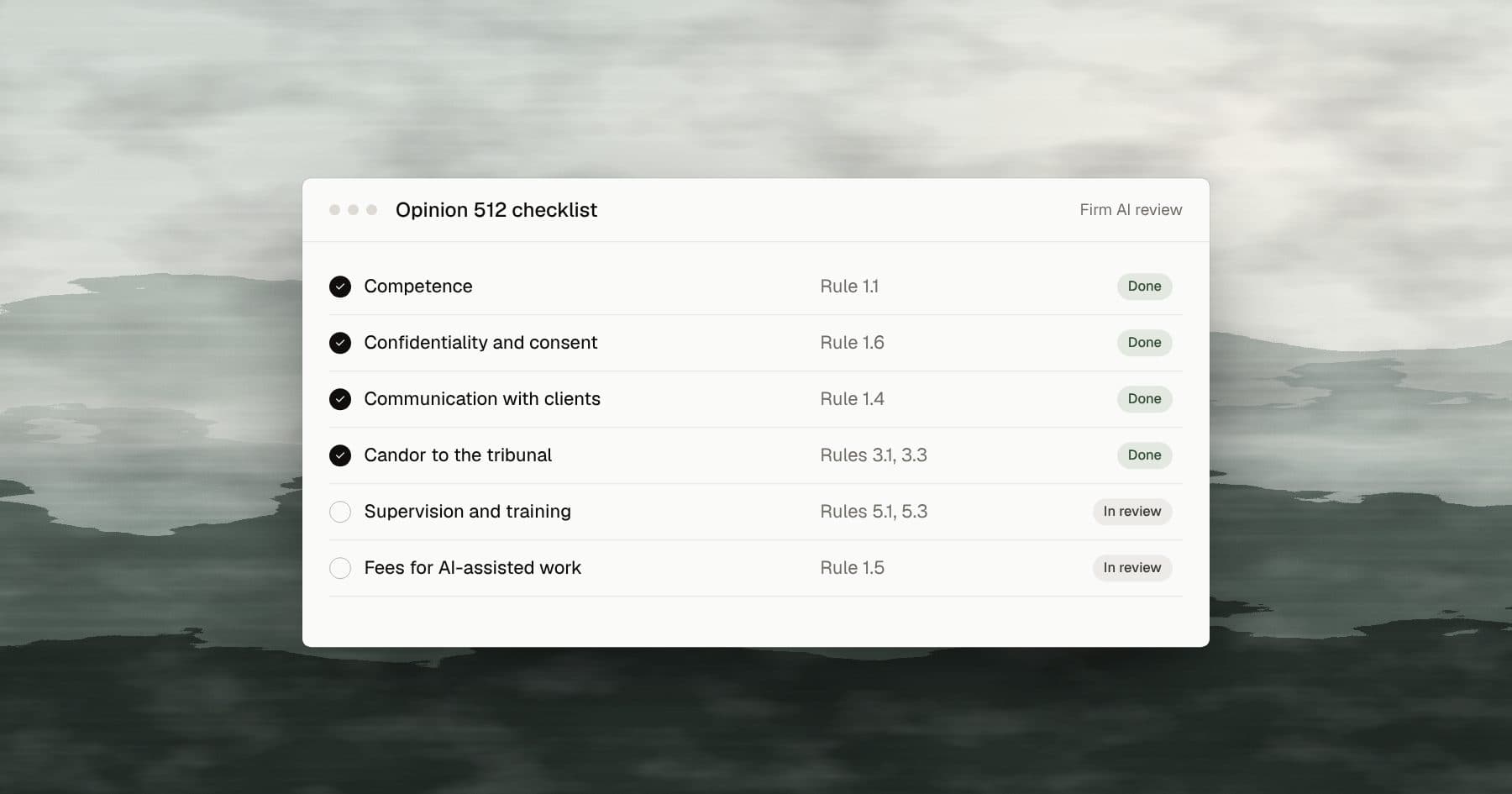
On July 29, 2024, the ABA Standing Committee on Ethics and Professional Responsibility issued Formal Opinion 512, its first opinion on generative AI. It creates no new rules. It explains how the Model Rules you already follow apply when a lawyer uses tools such as ChatGPT, Claude, Harvey, Legora or CoCounsel. Here is what it asks of you, duty by duty, and a checklist to put it into practice.
Why Opinion 512 Matters Even Though It Is Not Binding
ABA formal opinions interpret the Model Rules; they do not bind courts or disciplinary authorities. In practice, though, state bars have reached very similar conclusions, among them the State Bar of California's practical guidance (November 2023), Florida Bar Ethics Opinion 24-1 (January 2024), the joint Pennsylvania and Philadelphia Bar opinion 2024-200, New York City Bar Formal Opinion 2024-5 and Texas Opinion 705 (February 2025). Opinion 512 is the clearest single statement of the common ground, so it is the best place to start. Always check your own state's rules and guidance as well.
Competence (Rule 1.1): Understand the Tool, Check the Output
You do not need to become an AI expert, but you need a reasonable understanding of what the tools you use can and cannot do, and you need to keep that understanding current. That includes knowing that generative AI can produce confident, fluent and wrong answers.
The opinion is clear that you cannot rely on output uncritically. How much independent checking is needed depends on the task: using AI to brainstorm or to produce a first rough draft needs less review than relying on it for a legal conclusion, a summary of a document you have not read, or a citation you will put before a court.
Confidentiality (Rule 1.6): Know Where Client Information Goes
Before you enter information relating to a representation into an AI tool, you must assess the risk that it will be disclosed or accessed, inside or outside the firm. Read the tool's terms of use, privacy policy and data-retention terms, or have someone qualified read them for you.
For self-learning tools, which may use what you enter to improve the model or answer other users, the opinion says the client's informed consent is required before you input information relating to the representation. A general, boilerplate clause in an engagement letter is not enough: the client must understand the specific risks and benefits. Business plans that contractually exclude your data from training, and tools deployed inside your own environment, reduce this risk, but you still need to understand their terms.
Communication (Rule 1.4): When You Must Tell the Client
Opinion 512 treats disclosure as fact-specific. You should tell the client about your use of AI when:
- The client asks how you are doing the work, or whether you use AI.
- The engagement terms or the client's outside counsel guidelines require it.
- You need the client's informed consent under Rule 1.6, as above.
- The output will influence a significant decision in the matter, such as an assessment of likely litigation outcomes or jury selection.
- Your use of AI affects the basis or amount of the fee.
Candor and Meritorious Claims (Rules 3.1, 3.3 and 8.4(c))
Everything you file must be supported by real law and accurate facts, whoever or whatever drafted it. Courts have sanctioned lawyers for briefs containing cases that AI invented, starting with Mata v. Avianca in 2023. Read every authority you cite, confirm it says what the brief says it says, and confirm it is still good law. Check, too, whether the court has a local rule or standing order on AI disclosure or certification; a growing number of judges have one.
Supervision (Rules 5.1 and 5.3): Policies, Training and Vendors
Partners and supervising lawyers must make reasonable efforts to ensure that everyone in the firm uses AI in line with the rules. In practice that means a written AI-use policy, training for lawyers and staff, and clear rules on which tools are approved. The same supervisory duties apply to people and vendors outside the firm, including outsourced legal support providers and the AI vendors themselves.
Fees (Rule 1.5): Bill Time Spent, Not Time Saved
The fee guidance is the part of the opinion most firms need to act on:
- Hourly billing must reflect time actually spent, including time spent writing prompts and reviewing and correcting output. You may not bill for the time the tool saved you.
- Flat fees remain permitted, but the fee must still be reasonable.
- You generally may not charge clients for time spent learning a tool you will use across your practice. If a client asks you to use a specific tool, billing the time to learn it may be appropriate.
- General-purpose AI built into your everyday software is overhead and cannot be charged to clients as a cost. The actual cost of a tool used for a specific matter can be passed on, if you told the client in advance, and without a markup unless the client agreed to one.
A Checklist You Can Use Today
- List the AI tools your firm uses and confirm each is on a business plan whose terms you have read.
- Decide which categories of client information may be entered into which tool.
- Update your engagement letter to describe your AI use specifically, and get informed consent where Rule 1.6 requires it.
- Adopt a written AI-use policy and train everyone who works on client matters, including contractors and outsourced teams.
- Require a person to verify every citation and every factual statement before anything is filed or sent.
- Check the local rules and standing orders of every court you appear in for AI disclosure requirements.
- Review your billing practices: record actual time, decide which work moves to flat fees, and treat general AI tools as overhead.
- Revisit all of this at least once a year; the tools and the guidance are both changing fast.
How Prodigy LPO Works Within Opinion 512
We draft with AI only in tools your firm approves, or in business accounts set up so your files are not used for training. A qualified lawyer checks every fact and pulls every citation before work leaves us, your attorney supervises and signs, and we follow your firm's AI policy as well as our own. Send us one real task as a free sample, under NDA.
Sources
- ABA Formal Opinion 512, Generative Artificial Intelligence Tools (July 29, 2024)
- ABA Model Rules of Professional Conduct 1.1, 1.4, 1.5, 1.6, 3.1, 3.3, 5.1, 5.3 and 8.4
- Florida Bar Ethics Opinion 24-1 (January 19, 2024)
- State Bar of California, Practical Guidance for the Use of Generative Artificial Intelligence in the Practice of Law (November 2023)
- New York City Bar Association Formal Opinion 2024-5; Pennsylvania Bar Association and Philadelphia Bar Association Joint Formal Opinion 2024-200; State Bar of Texas Opinion 705 (February 2025)
- Mata v. Avianca, Inc., No. 22-cv-1461 (S.D.N.Y. June 22, 2023)
This guide is general information for lawyers, not legal advice. Check the current rules in your jurisdiction.
One Practical Guide a Month
Short, useful guides for US attorneys on legal AI, outsourcing and running a leaner practice. One email a month; unsubscribe in one click.