
How to Bill for AI-Assisted Legal Work Without Breaking the Ethics Rules
By Avish Sharma, advocate. Published November 10, 2026. 6 min read.
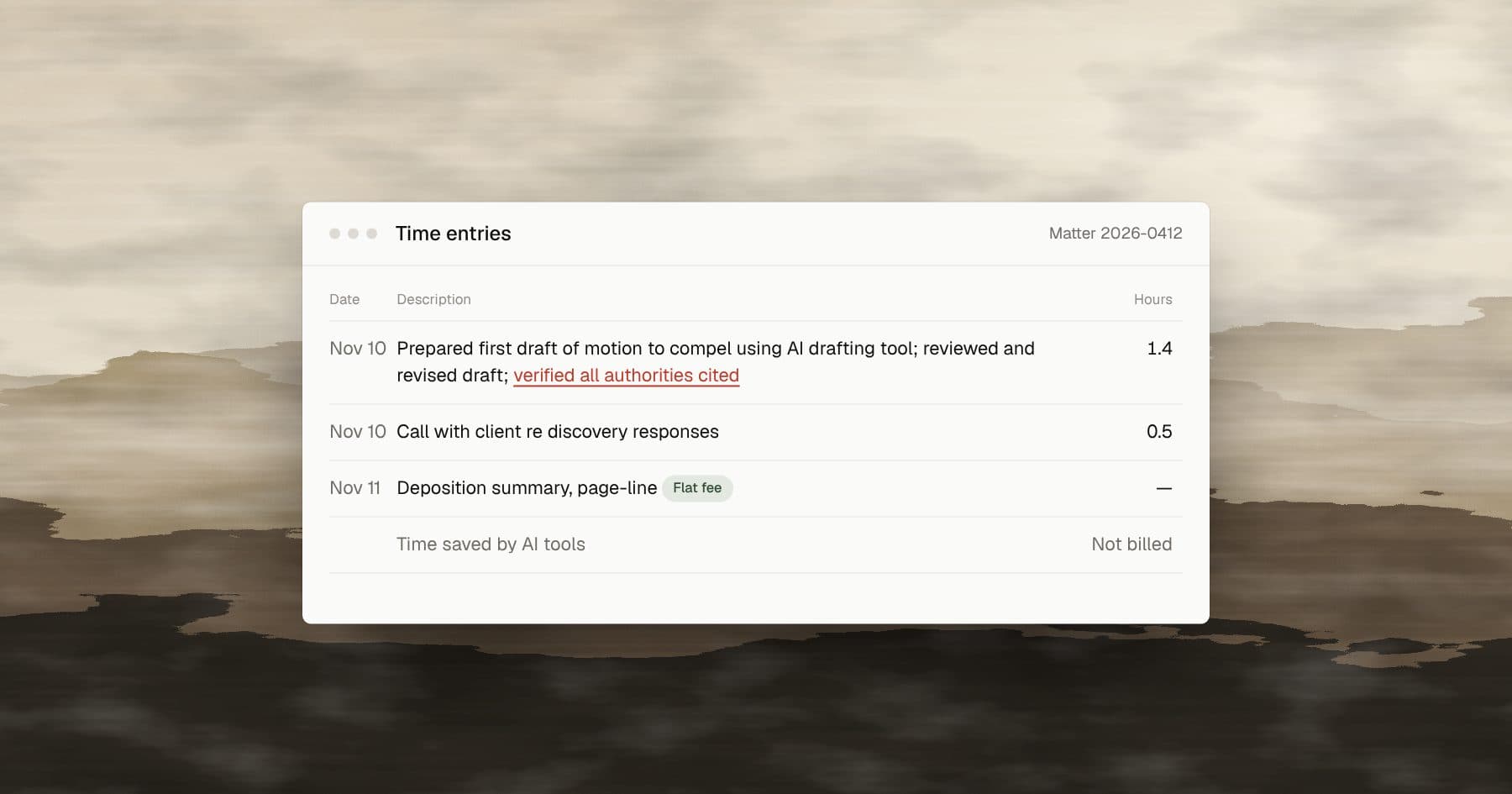
Generative AI creates an awkward problem for firms that bill by the hour: the better the tools get, the fewer hours there are to bill. The ethics rules do not let you fill the gap by billing time you did not spend. They do leave room for pricing models that let you keep the value of working faster. Here is how to bill AI-assisted work in a way that is both ethical and profitable.
Why This Matters Now
Most lawyers already bill only a fraction of their day. Clio's 2025 Legal Trends Report puts the average utilization rate at 38%, about three billable hours in an eight-hour day, with 88% of that work invoiced and 93% of invoices collected. If AI takes an hour out of a three-hour task and you bill strictly by the hour, your revenue falls by a third for that task. Firms that think about pricing now will keep the benefit of the tools; firms that do not will hand it all to their clients.
What the Rules Say
Rule 1.5 requires fees to be reasonable. ABA Formal Opinion 93-379 has long said that a lawyer who agrees to bill by the hour may bill only the hours actually spent. Formal Opinion 512 (2024) applies that directly to generative AI: an hourly biller may charge for the time spent writing prompts and reviewing and correcting output, but not for the time the tool saved.
Opinion 512 adds that time spent learning a tool you will use across your practice is generally not billable, that AI built into your ordinary software is overhead, and that the actual cost of a tool used on a client's matter may be passed on if you disclose it in advance. Florida Bar Ethics Opinion 24-1 likewise says lawyers should tell clients, preferably in writing, if they intend to charge the actual cost of using generative AI, and that AI must not lead to duplicate charges or inflated time.
Option 1: Stay Hourly, and Record Time Honestly
Hourly billing still works for open-ended work such as litigation strategy, negotiation and advice, where the time depends on judgment rather than drafting. Record the time you actually spend, describe what you did, and include review: "Prepared first draft of motion to compel using AI drafting tool; reviewed and revised draft; verified all authorities cited (1.4)." Entries like this show the client both the efficiency and the professional work that made the draft safe to file.
Option 2: Move Repeatable Work to Flat Fees
Flat fees are where AI efficiency becomes margin instead of a discount. When you price by the task, the client pays for the result, and you keep the benefit of producing it faster. The fee must still be reasonable under Rule 1.5, but a fair market price for a deliverable does not have to fall each time your process improves.
Good candidates are tasks whose scope you can define in advance:
- Chapter 7 and Chapter 13 petitions and schedules.
- Trademark clearance searches and applications.
- Deposition summaries, priced per transcript or per hundred pages.
- Medical chronologies and demand letters in personal injury matters.
- Wills, trusts and powers of attorney prepared from a standard intake.
- Contract reviews against a defined checklist.
Option 3: Subscriptions and Hybrid Pricing
For ongoing clients, a monthly fee covering a defined amount of routine work, with hourly or flat-fee pricing for anything outside it, gives the client predictable costs and gives you steady revenue. Hybrid models also work well in litigation: a flat fee for each phase, such as pleadings, written discovery or summary judgment, and hourly billing for trial.
Passing On the Cost of AI Tools
Treat your general AI subscriptions as overhead, built into your rates, in the same way as your word processor or research subscription. If a matter needs a specialized tool with a per-use or per-matter cost, you can charge the actual cost as an expense, provided you told the client in advance, ideally in the engagement letter. Do not add a markup to a cost unless the client has agreed to it.
What to Put in Your Engagement Letter
- That the firm uses AI tools for specified kinds of work, and that a lawyer reviews all output.
- How client information is protected in those tools, and, where Rule 1.6 requires it, the client's informed consent.
- Which work is billed hourly and which at a flat fee.
- Whether any tool costs will be charged as expenses, and at actual cost.
- Whether the firm uses outsourced lawyers or paralegals, how they are supervised, and how their work is billed.
Billing for Outsourced Work
The same principles apply when you outsource. ABA Formal Opinion 00-420 allows a firm that bills a contract lawyer's work as legal services to add a surcharge, as long as the total fee is reasonable; if the work is billed as a cost, the charge should not exceed the actual cost plus directly associated costs unless the client agrees otherwise. Opinion 08-451 confirms that these principles extend to outsourced work, including work done overseas, and that the firm must supervise it and protect client confidences.
Combining AI with outsourced support is how many small firms now price competitively: the first draft is produced quickly and cheaply, a qualified reviewer checks it, and the attorney's time goes into judgment and sign-off.
Sources
- ABA Formal Opinion 512, Generative Artificial Intelligence Tools (July 29, 2024)
- ABA Formal Opinion 93-379, Billing for Professional Fees, Disbursements and Other Expenses (1993)
- ABA Formal Opinion 00-420, Surcharge to Client for Use of a Contract Lawyer (2000)
- ABA Formal Opinion 08-451, Lawyer's Obligations When Outsourcing Legal and Nonlegal Support Services (2008)
- Florida Bar Ethics Opinion 24-1 (January 19, 2024)
- Clio, 2025 Legal Trends Report (utilization, realization and collection benchmarks)
This guide is general information for lawyers, not legal advice. Check the current rules in your jurisdiction.
One Practical Guide a Month
Short, useful guides for US attorneys on legal AI, outsourcing and running a leaner practice. One email a month; unsubscribe in one click.